How do we train the dogs when there is no snow
A question we often hear from our guests is: What do your dogs actually get up to when there’s no snow?
Our dogs are competitive athletes and, just like with human atheletes, it’s therefore not possible to simply take a month-long break and then get back into the swing of things straight away. That’s why we train even when there’s no snow.
Why do our dogs need to be trained at all?
First of all, let’s take a look at how we actually train when there’s snow on the ground. Our dogs are Alaskan Huskies, a breed that is extremely hardy and therefore needs plenty of exercise. Our dogs usually train five days a week; the other days are rest days. Huskies that don’t get enough exercise will eventually go mad (no joke!) and try to burn off their excess energy themselves, which carries a certain risk of injury. That’s why regular training is very important. Our dogs feel most at home with plenty of snow under their paws and cold temperatures; -20 to -30 degrees is always a comfortable temperature for them here. In winter, we train with the sled, of course, but also with a snowmobile when there’s a large group (16–20 dogs) to train. The dogs are then harnessed to the snowmobile and pull it whilst the engine is idling or with a slight touch of the throttle.
The length of the training sessions varies depending on the dogs’ age and the group they belong to; our A-team is preparing for the big races and often trains over longer distances, even overnight, whilst, for example, our youngsters – who are only just getting used to the idea – need to learn to pace themselves over longer distances.
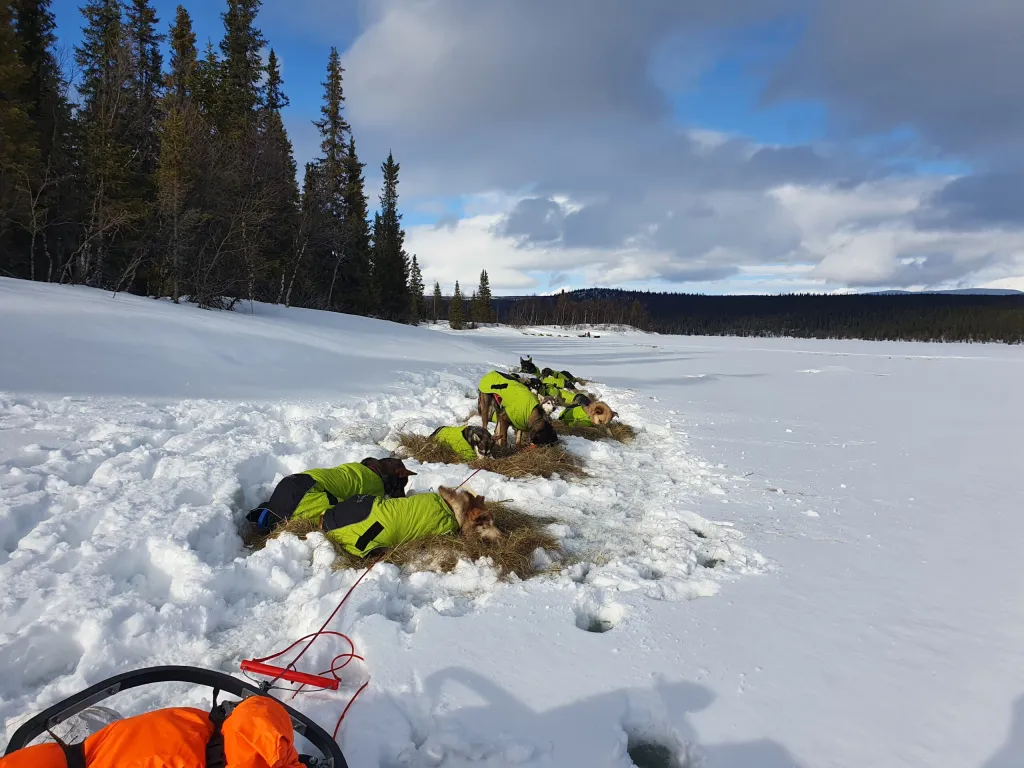
A very important part of our winter training is, of course, our multi-day tours. On these tours, we have dogs on their way to the A-Team alongside those who have retired from active racing. Our setup for the tours teaches the dogs a race-like routine. For example, they learn to settle down during the lunch break, just as they would during a break on the trail in a race (though, of course, it’s also very nice for our guests 😉 ).
Training in SPring and Autumn without snow
First of all, it must of course be said that we usually still have snow until mid-May and have the first again in the beginning of November. As long as there’s a proper layer of snow, we can of course train with the sleds.
As soon as there’s too little snow to train with the sled, we switch to quad bikes and ATVs. Another option is the so-called ‘troll kart’, which is similar to a sled on wheels. The musher stands at the back of the troll kart and can control the speed using hand brakes, whereas on a traditional sled they would control it with their feet.
Teams of 12–20 dogs are harnessed to these and pull them at a slow pace. At a certain point, however, it starts to get warmer during the day. We train with the dogs as long as temperatures are in single figures; above that, if it gets too warm during the day, we move the training to the early morning and evening, or even at night. Because from the end of April onwards, we naturally have a clear advantage: the midnight sun arrives – so it simply doesn’t get dark anymore. So it makes almost no difference whether you’re outside at 2 pm or 2 am – the light is almost the same.
However, once the temperature no longer drops below 10 degrees even at night, we stop training. Instead, the dogs are put on the wheel regularly (just as in winter).

Training sleddogs in the Wheel
We use the training wheel to train the dogs, often in combination with a training session in front of the sled. It is a rotating device with separate compartments, which the dogs can, however, run underneath at any time. The rotation speed can be adjusted individually. The advantage here is that the dogs aren’t pulling, but simply running, and so it’s a variation of training for them. It also gives us the chance to watch the dogs running from the side (otherwise, on the sled, all you get to see are their lovely backsides…😉). This allows us to assess their running patterns differently and take this into account during training. Dogs returning from an injury lay-off or after a maternity leave are also gradually re-acclimatised to running using the wheel.
Summer break
During the summer, when it’s too hot at any time of the day or night, our dogs have a break from training. Instead, we let them run freely in the grounds to burn off energy or do short laps in the wheel. We also fit awnings to the kennels to provide the dogs with more shade.
However, as soon as the temperatures drop again – usually from mid-August/early September – we gradually resume our ATV training. We start with just short sessions, gradually increasing the duration from week to week, so that we’re back up to the normal training level required for the tours just in time for the start of the season.
What's important to keep in mind during no-snow training?
Body Temperature
Dogs cannot sweat like humans to regulate their body temperature, so it is extremely important to keep an eye on their temperature. That is why we have several spots where we make use of water holes or streams so that the dogs can cool off there.

Hydration
As they cannot eat snow to compensate for water loss, as they do in winter, it is important to take frequent drinking breaks to ensure the dogs stay hydrated. To this end, we take several canisters of water and bowls with us, which are used repeatedly during these breaks.

Paw care
Anyone who has been on a tour with us before knows that, before every start, we first check all the paws and prepare them according to the conditions, for example by using booties or a special cream containing grease and zinc called Winterpad that we get from our sponsor Axaeco. Even when there is no snow on the ground, paw care is extremely important, as we sometimes run on gravel paths. It’s particularly important to prevent cuts when the ground starts to freeze. However, we usually schedule our training sessions for times when the sun has already slightly thawed the top layer, creating a softer surface.

Shortened routes
Naturally, we cannot train over distances as long as we do in winter. Instead, we shorten the distance and reduce the team’s speed, whilst taking more frequent breaks.
Want to learn more?
We love talking about our dogs, their training and breeding. You are welcome to book a kennel visit to take a closer look at our facilities and find out more about our sport. All our tours have a kennel visit included already.